skip to main | skip to sidebar

The Federal Reverse

Stocks


Forex

Treasury bonds

Twitter feed

Blog Archive

  • ▼  2014 (1)
    • ▼  January (1)
      • Beware Chinese phones!
  • ►  2013 (13)
    • ►  December (2)
    • ►  March (2)
    • ►  February (4)
    • ►  January (5)
  • ►  2012 (71)
    • ►  December (2)
    • ►  October (3)
    • ►  September (10)
    • ►  August (7)
    • ►  July (6)
    • ►  June (9)
    • ►  May (11)
    • ►  April (13)
    • ►  March (10)

Categories

  • altcoins (1)
  • Android (1)
  • Astronomy (1)
  • banks (8)
  • Bernanke (2)
  • BFA-Bankia (3)
  • biology (2)
  • Bitcoin (1)
  • Bonds (8)
  • bubble (6)
  • CDS (2)
  • Central banks (14)
  • Chavez (1)
  • chinese phones (1)
  • college (1)
  • commodities (9)
  • compound interest (1)
  • corn (2)
  • corralito (2)
  • cotton (1)
  • Credit (12)
  • credit rating (2)
  • crisis (18)
  • Crisis Trivia (1)
  • currency (5)
  • debt (16)
  • deflation (9)
  • degree (1)
  • ECB (14)
  • Economics (13)
  • Economy (20)
  • Energy (10)
  • ESM (1)
  • Euro (9)
  • Europe (24)
  • EURUSD (7)
  • farming (5)
  • Fed (8)
  • finance (12)
  • Forex (3)
  • France (2)
  • futures (4)
  • Germany (14)
  • Gold (19)
  • Greece (11)
  • hed (1)
  • hedge funds (2)
  • hum (1)
  • humor (12)
  • Huxley (1)
  • Iberia (1)
  • IMF (1)
  • India (1)
  • inflation (22)
  • interest rates (6)
  • Internet (1)
  • investing (3)
  • Iran (1)
  • Jack Andraka (1)
  • Jim Rogers (3)
  • lies (1)
  • LTRO (1)
  • Marc Faber (5)
  • mone (1)
  • Money (17)
  • normalcy bias (4)
  • oil (2)
  • Orwell (2)
  • OWS (1)
  • Portugal (2)
  • real estate (5)
  • regularization (1)
  • Silver (9)
  • society (19)
  • sociopaths (19)
  • Spain (22)
  • speculation (5)
  • splines (1)
  • stocks (1)
  • trading (15)
  • UK (2)
  • university (1)
  • USA (8)
  • Venezuela (1)
  • wages (3)
  • Wealth (8)
  • welfare state (2)
  • wheat (2)

Daily read

  • Bloomberg
  • FT's Seeking Alpha
  • Silver Gold Silver
  • The Fundamental View
  • Zero Hedge

The Federal Reverse

Loading...
Powered By Blogger
Powered by Blogger.
  • Main page

World Statistics

SlideME CrisisTrivia

Get the Crisis Trivia Android app from SlideME.

Followers

Search This Blog

Tuesday, April 10, 2012

Spanish housing bubble and economic annihilation


I came across this wonderfully made video that would be a total LMFAO if there were no people suffering from the topic it talks about. It offers a simple explanation of why the country got to the its current state. The audio is in Spanish but it has English subtitles.

The Guadian has recently released an article featuring the town of Seseña, south of Madrid, the prime example of the Spanish overdeveloping and paradigm of the housing bubble.
Half a quarter million people have been foreclosed and it is estimated that another 200.000 mortgages will go underwater over 2012. The majority of the working population is being hit with ever-increasing taxes, transport and electricity bills.

Consumption is resenting, retail profits falling and margins compressing so much that a tsunami of shops not opening the next day is hitting the Spanish main street. This deflationary effect, as I mentioned previously, comes from both fear (of losing the job) and real monetary contraction (M1 monetary base is fleeing the country and being used to pay the credit granted some 10 years ago, putting inflationary pressure on Germany and other net-creditor nations).

The sole collateral the Spanish banking system has is real estate. Flats meant for a middle class that is now non-existent, underemployed or unemployed, with no possible rebound in the near future and even the possibility of losing an entire generation if the 50 percent young unemployment settles, which is very likely due to the continued loss of industrial activity over the last 30 years and a burdensome bureaucracy that prevents entrepreneurship.

There is a lot of talk on Zerohedge about Spain. I believe the situation in Spain will worsen, and that those employed will face the costs of a failing banking system with a real-estate problem. In the financial world, the time for Spanish banks to hide their balance sheets is over. One day, no ECB cheap credit will be able to sustain both those failed banks and southern sovereign bonds without getting the EU into a hyperinflationary spiral. There is definitely something very fishy when Spain's PM avoids the press like this:

Posted by Analytic Bastard at 4:05 PM 2 comments
Labels: bubble, crisis, real estate, Spain, wages, Wealth

Sunday, April 8, 2012

That raid of mine proved to be wise after all

For those of us who live in Euroland, it is very important to observe Gold/EUR correlations, since an extreme deviation from linear correlation provides an excellent opportunity to put some coins in your hand. When I say deviation from linear correlation I mean that Gold moves orders of magnitude more than the EUR, in the sense that when you look at the graph you stop recognizing the usual correlation that you could normally see in the chart. When that happens, price usually goes to a level that would normally require two or three months to reach stability, but just for a brief time in the day.

I got some coins at a German seller the other day at the lowest possible price simply because I was seeing the correlation dilate so much, with the EUR pretty much untouched and Gold getting hit. That non-linear correlation between them put the price at levels not seen since October 2011 and I had seen many times how brief that window of opportunity can be. That, and the fact that the situation with Spanish sovereigns and banks may explode again, I loaded up and checked out.

So, even though I think we are currently in a deflationary destruction of the working class, I recognized that event as a unique opportunity to average on the downside. Those coins are each 25 EUR more expensive with today's gap up.

I also took the opportunity to get a stack of some beautiful silver Chinese 2012 Pandas, which seem to have been released just recently.

Posted by Analytic Bastard at 3:46 PM 0 comments
Labels: Euro, Europe, Germany, Gold, Silver, Spain

Towards a thermodynamical theory of Economics

Even though Economics is a topic studied at every college and university, I believe their core fundamentals are not only misunderstood but also not even identified.

When I speak with economists, they fool around specific ideas they learned, but I came to realize that economic systems are nothing more than physical systems, and the same concepts and rules should apply.

If we admit that the economy is a physical system whose magnitudes change with time and in space, we need to match economic concepts to those of Physics. I propose to identify energy to wealth, work to labor and heat to money. Then we inherit the set of laws of thermodynamics. In particular, if we consider the economy in a society as a set of hierarchical thermodynamical systems, it is evident that the
  • First law of thermodynamics: Heat and work are forms of energy transfer. While energy is invariably conserved, the internal energy of a closed system changes as heat and work are transferred in or out of it. Equivalently, perpetual motion machines of the first kind are impossible.
comes in place when somebody (first) does some work for a second person (another system). Wealth (energy) has been transferred by the labor executed by the first person to the second in the form of an elaborated product that could not have existed without the first person losing energy (transferring it in the form of work to the second person). If it is expected that the first person received a monetary compensation, the energy loss is therefore restored if this compensation is "fair" (in abstract terms of the money transfer being equivalent to the labor transfer). If the person executing the labor is a slave, this reduces to a system that continuously transfer energy out of it, much in the way the sun does, or does the process creating crude oil (both transfer energy to the human society as a whole system, and at their expense).

It is also evident that someone that has more money can move faster and farther away than someone whose occupation is mundane and provides a low income. This fact reinforces this thermodynamical view of Economics.

Studying inflationary and deflationary processes under these lenses would provide new insights into wealth transferring periods. In this theory, money is just a mean for wealth (energy) transfer, not for wealth storage. In this sense, a natural distinction can be made between paper currency and hard monetary assets such as gold. Both serve as wealth transfer mechanism (heat), but only one is stable.

Under this theory, crude oil would have a much deeper impact on the economy than just a mere impact on industrial manufacturing prices. Much more than that, oil would provide the energy needed for the system to growth (and especially to cope with the compound interest and the exponential growth it requires). Crises and equity peaks can easily be explained and predicted (disregarding timing).

Unless economists take a more humble position and view themselves as just a part of the whole body of laws that govern the entire universe, and not take refuge under the excuse that the "complex human behavior" makes the theory different, we will be doomed to hear experts predict decades of booming economy at peaks and missing opportunities at bottoms.
Posted by Analytic Bastard at 6:14 AM 0 comments
Labels: Central banks, Credit, deflation, Economics, Economy, Energy, Gold, inflation, Money, Wealth

Saturday, April 7, 2012

A financial Pilgrimage of Grace

I'm sorry but this is what came up when I first saw the announcement of a congregation of independent day traders under the banner of Turd Ferguson. To be honest, I could not believe what my eyes were seeing. And all of that sponsored by the famous whistleblower A. McGuire, reappearing out of thin air, once again. I could not help but bearing in mind people following the banner of the Pilgrimage of Grace:
To put more wood into the fire, they name themselves "Turd's army" and have the holy mission of making huge profits in the paper markets, cash them and get physical metals with them, with the help of some Antioch grenade that signals when manipulators are taking the price down (now that permabulishness has turned to be catastrophically unprofitable).

I don't know what is with these permabullish people. If somebody manipulates down the price of gold then that somebody is my friend without any doubt. That makes that "army" my enemy, if their plan is to force prices higher in the short term.

In any case, good luck to them.
Posted by Analytic Bastard at 7:32 PM 0 comments
Labels: Central banks, futures, Gold, Silver, trading

Inflationary concerns

Zerohedge has regularly been reporting the ECB's deposit facility that the banks use as storage, much in the same way a customer uses a current account with his bank (except that they are penalized for not putting this fresh credit-created money in circulation). As ZH reports, banks have been depositing the whole of both LTRO 3-year loans in those accounts. This means that the current mood in the banks is not risk-prone and in line with a fear-driven deflation.


As of today, the banks seem to have found some place to allocate those funds, most likely in sovereign debt.

As I noted previously, prices are going up in those countries less affected by the crisis. In those countries, credit-based assets are going bubbly. In the whole EU, food and basic products are seeing how the money that was supposed to be destined to pay the now-underwater mortgages and other credit-based products acquired over the past ten years is duplicated and redirected to basic products by the chain created by ECB-banks-states. In this case, prices simply go up in creditor nations (Germany, Austria...) whereas they are stable in debtor nations (Spain, Portugal) due to retail and industrial margin reductions.

This will have the effect of wiping out retailers and manufacturers in southern countries, while creating housing bubbles and general inflation in central countries. And this will not end here: both LTRO programs, surpassing 1 trillion EUR, and the risk of the need for another 3.0 version, is a money stream with enough pressure to break the fear-deflationary dam that currently prevents it from flooding the markets and spurring the effect of losing confidence in the currency and its issuer.

As I say: brace yourselves.
Posted by Analytic Bastard at 7:02 PM 0 comments
Labels: Bonds, CDS, Central banks, Credit, deflation, ECB, Europe, Fed, Germany, Greece, inflation, Money, Portugal, Spain

Thursday, April 5, 2012

I got myself some gold yesterday (with an outlook)

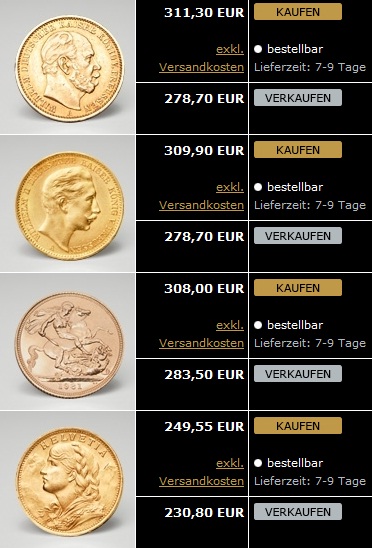
I often follow the stock in Geiger Edelmetalle, since they show the coins they have and the number of each when you place your order. Here's a screenshot of four fractional-ounce coins that I have found to be out of stock in gold rallies.

The first is the 20 gold Mark Kaiser Wilhelm I, winner of the French-Prussian war and founder of the German Empire. These coins are more loved by the German people in comparison to his grandson Wilhelm II, even though their state is normally poorer due to a larger circulation (they were valid from 1871 until the first world war, whereas those of the grandson went from 1891 on, and larger mintages of the grandson's image are dated in the 1900). This means that coins depicting Wilhelm I are depleted quickly, whereas Wilhelm II 20 gold marks tend to remain in stock.
This is the British sovereign. This is a coin that is also depleted quickly due to its national origin (it is interesting to own national coins since they are the most accepted ones in their respective countries).
Lastly, we have the Swiss Vreneli 20 francs, another popular coin and usually found in ample supply.

Were these four coins missing, along with some of the one-ounce coins, I would be inclined to say that there is physical market pressure on the price. However, as we can see as of April 5th, the four coins remain in stock. I think that sustained high prices (with a record in EUR) have provided shops with more stock, and physical market pressure is relieved.

However, a good strategy when investing in gold is averaging on the downside. With the metals plunging during two straight days, and gold price not that low since January, it was time to raid a shop. This does not mean that I think it won't continue sliding. USD1500 is fully believable. It may coincide with a market-wide spring sell-off in a deflationary context, and in that case the drop might be much larger. The chart in EUR tells me there is some barrier at EUR1350 that gold was not able to cross and, thus, it has to take a breath. On the other hand, the problems in southern Europe lurking, are poised to surface again. This has been proven to be true, at least partially, with today's EUR dumping across the board. At that time, it was clear that the minimum for the day was in (assuming normal trading). The elements for averaging on the downside were on! The price per ounce I got yesterday was EUR1265 (Krugerrand, not in Geiger). Today it is EUR1282, not a bad deal!
Posted by Analytic Bastard at 8:23 AM 0 comments
Labels: Central banks, deflation, ECB, Gold, inflation, Silver

Monday, April 2, 2012

Our fiat monetary system

If von Misses sounds to you like you left something at home, in the same line that our previous post, here you have, via Zero Hedge:


And this quote by George Washington, also selected by ZH, but that I want to carbon copy here along some other fitting quotes:
"Paper money has had the effect in your state that it will ever have, to ruin commerce, oppress the honest, and open the door to every species of fraud and injustice"
George Washington -- in a letter to Jabez Bowen, Rhode Island
“The first panacea for a mismanaged nation is inflation of the currency; the second is war. Both bring a temporary prosperity; both bring permanent ruin”
 Dr. Marc Faber quoting Ernest Hemingway in the CFA Institute Middle East Investment Conference
"I will pay cash or pay nothing." "I will never resort to irredeemable paper money"
Napoleon Bonaparte
"Let me issue and control a Nation's money and I care not who makes its laws"
Mayer Amschel Bauer Rothschild

Posted by Analytic Bastard at 1:44 AM 0 comments
Labels: Central banks, Credit, debt, ECB, Fed, Gold, inflation, Marc Faber, Money, real estate, wages
Newer Posts Older Posts Home
Subscribe to: Posts (Atom)

Energy


Precious metals

gold coin prices junk silver coins

Popular Posts

  • Debunking Jim Rogers on farming
    Jim Rogers has been speaking a lot about farming being the profession of the future. Now, I love his insights and I regard him as one of the...
  • Spanish housing bubble and economic annihilation
    I came across this wonderfully made video that would be a total LMFAO if there were no people suffering from the topic it talks ...
  • A tale of exponential interest
    Imagine you have a savings account and you deposit an amount. The bank transfers the interest to your account and the next time you get inte...
  • The truth about Jack Andraka
    The truth about Jack Andraka is... that I don't know it, obviously, I am a normal citizent with my mundane whereabouts and I am geograph...
  • Towards a thermodynamical theory of Economics
    Even though Economics is a topic studied at every college and university, I believe their core fundamentals are not only misunderstood but a...
  • Beautiful spectacle in the sky
    I enjoy Astronomy so much that I examine the night sky every time I can. Tonight I couldn't wait to describe the delightful sight in t...
  • Inflationary concerns
    Zerohedge has regularly been reporting the ECB's deposit facility that the banks use as storage, much in the same way a cust...
  • That raid of mine proved to be wise after all
    For those of us who live in Euroland, it is very important to observe Gold/EUR correlations, since an extreme deviation from linear correlat...
  • Dark pools, algorithms and HFT
    I found an interesting piece at ZH that I want to maintain in this blog. It is from this just-released book Dark Pools: High-Speed Trader...
  • Two videos aus Deutschland
    The first starts with Dirk "Mr.Dax" Müller, slamming the door pretty hard on those that only see an unlikely interest rate ...

Worthy analyses

  • SeekingAlpha.com: Home Page
    Madison Air Group: A Solid Performance, But Questions Around A Recent Deal
    19 minutes ago
  • mathbabe
    AI Skeptics: How Schools Procure AI Tools (with J.B. Branch)
    8 hours ago
  • FOFOA
    Hyperinflation Book Club
    1 week ago
  • The Fundamental View
    Perumahan Murah di Pekalongan 2026: Subsidi, KPR, dan Info Terbaru
    2 months ago
  • Humble Student of the Markets
    A Time for Caution
    6 months ago
  • Shadow Government Statistics
    Flash Commentary No, 1460b
    5 years ago
  • www.zerohedge.com/fullrss2.xml
    The Oil Refinery Crisis Will Worsen This Winter
    5 years ago
  • Jim Rogers Blog
    Financial Markets Will Move To Asia
    6 years ago
  • Kyle Bass Blog
    Kyle Bass On China
    10 years ago
  • Big Picture Agriculture
  • SilverGoldSilver
  • Harvey Organ's - The Daily Gold and Silver Report
  • Marc Faber Blog

Label cloud

Europe (24) Spain (22) inflation (22) Economy (20) Gold (19) society (19) sociopaths (19) crisis (18) Money (17) debt (16) trading (15) Central banks (14) ECB (14) Germany (14) Economics (13) Credit (12) finance (12) humor (12) Greece (11) Energy (10) Euro (9) Silver (9) commodities (9) deflation (9) Bonds (8) Fed (8) USA (8) Wealth (8) banks (8) EURUSD (7) bubble (6) interest rates (6) Marc Faber (5) currency (5) farming (5) real estate (5) speculation (5) futures (4) normalcy bias (4) BFA-Bankia (3) Forex (3) Jim Rogers (3) investing (3) wages (3) Bernanke (2) CDS (2) France (2) Orwell (2) Portugal (2) UK (2) biology (2) corn (2) corralito (2) credit rating (2) hedge funds (2) oil (2) welfare state (2) wheat (2) Android (1) Astronomy (1) Bitcoin (1) Chavez (1) Crisis Trivia (1) ESM (1) Huxley (1) IMF (1) Iberia (1) India (1) Internet (1) Iran (1) Jack Andraka (1) LTRO (1) OWS (1) Venezuela (1) altcoins (1) chinese phones (1) college (1) compound interest (1) cotton (1) degree (1) hed (1) hum (1) lies (1) mone (1) regularization (1) splines (1) stocks (1) university (1)

Machinomics

Machinomics
Visit my blog about data analysis, financial applications and science