skip to main | skip to sidebar

The Federal Reverse

Stocks


Forex

Treasury bonds

Twitter feed

Blog Archive

  • ▼  2014 (1)
    • ▼  January (1)
      • Beware Chinese phones!
  • ►  2013 (13)
    • ►  December (2)
    • ►  March (2)
    • ►  February (4)
    • ►  January (5)
  • ►  2012 (71)
    • ►  December (2)
    • ►  October (3)
    • ►  September (10)
    • ►  August (7)
    • ►  July (6)
    • ►  June (9)
    • ►  May (11)
    • ►  April (13)
    • ►  March (10)

Categories

  • altcoins (1)
  • Android (1)
  • Astronomy (1)
  • banks (8)
  • Bernanke (2)
  • BFA-Bankia (3)
  • biology (2)
  • Bitcoin (1)
  • Bonds (8)
  • bubble (6)
  • CDS (2)
  • Central banks (14)
  • Chavez (1)
  • chinese phones (1)
  • college (1)
  • commodities (9)
  • compound interest (1)
  • corn (2)
  • corralito (2)
  • cotton (1)
  • Credit (12)
  • credit rating (2)
  • crisis (18)
  • Crisis Trivia (1)
  • currency (5)
  • debt (16)
  • deflation (9)
  • degree (1)
  • ECB (14)
  • Economics (13)
  • Economy (20)
  • Energy (10)
  • ESM (1)
  • Euro (9)
  • Europe (24)
  • EURUSD (7)
  • farming (5)
  • Fed (8)
  • finance (12)
  • Forex (3)
  • France (2)
  • futures (4)
  • Germany (14)
  • Gold (19)
  • Greece (11)
  • hed (1)
  • hedge funds (2)
  • hum (1)
  • humor (12)
  • Huxley (1)
  • Iberia (1)
  • IMF (1)
  • India (1)
  • inflation (22)
  • interest rates (6)
  • Internet (1)
  • investing (3)
  • Iran (1)
  • Jack Andraka (1)
  • Jim Rogers (3)
  • lies (1)
  • LTRO (1)
  • Marc Faber (5)
  • mone (1)
  • Money (17)
  • normalcy bias (4)
  • oil (2)
  • Orwell (2)
  • OWS (1)
  • Portugal (2)
  • real estate (5)
  • regularization (1)
  • Silver (9)
  • society (19)
  • sociopaths (19)
  • Spain (22)
  • speculation (5)
  • splines (1)
  • stocks (1)
  • trading (15)
  • UK (2)
  • university (1)
  • USA (8)
  • Venezuela (1)
  • wages (3)
  • Wealth (8)
  • welfare state (2)
  • wheat (2)

Daily read

  • Bloomberg
  • FT's Seeking Alpha
  • Silver Gold Silver
  • The Fundamental View
  • Zero Hedge

The Federal Reverse

Loading...
Powered By Blogger
Powered by Blogger.
  • Main page

World Statistics

SlideME CrisisTrivia

Get the Crisis Trivia Android app from SlideME.

Followers

Search This Blog

Showing posts with label Energy. Show all posts

Tuesday, January 22, 2013

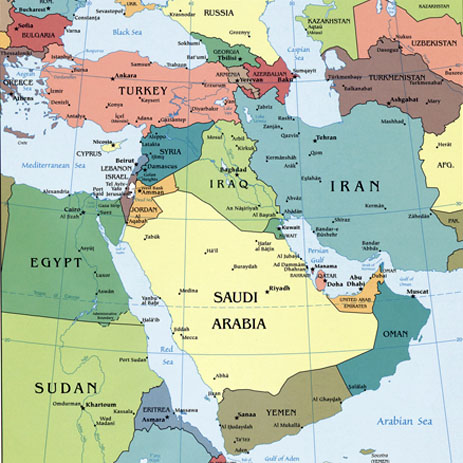
The Middle East: Somebody still thinks it is incidental?

Everybody knows that selling oil in any currency other than the USD is very dangerous, let it be EUR (Saddam Hussein) or gold (Muhammar Al-Gadhafi).

Let's look at this Middle East map:


From Zerohedge, the Iranian currency, the rial, has crumbled a 70% since the EU and the USA imposed sanctions on the country.
When President Obama signed the Comprehensive Iran Sanctions, Accountability, and Divestment Act, in July 2010, the official Iranian rial-U.S. dollar exchange rate was very close to the black-market rate. But, as the accompanying chart shows, the official and black-market rates have increasingly diverged since July 2010. This decline began to accelerate last month, when Iranians witnessed a dramatic 9.65% drop in the value of the rial, over the course of a single weekend (8-10 September 2012). The free-fall has continued since then. On 2 October 2012, the black-market exchange rate reached 35,000 IRR/USD – a rate which reflects a 65% decline in the rial, relative to the U.S. dollar.
In my opinion, the end game is in sight. Energy resources will be controlled by a small elite, and most of us will perish or will be become defacto slaves. A very nasty future lies ahead.
Posted by Analytic Bastard at 12:46 PM 0 comments
Labels: crisis, currency, Economy, Energy, inflation, Iran, USA

Wednesday, August 22, 2012

Children of cheap oil

You are not unique. You don't have any inherent human rights despite what politicians or accommodated philosophers tell you. You are part of a massive hive of 7bn humans wandering over the surface of an antinatural outcome.

You are the result of two billion years’ accumulated energy reserves.

You witness impassively at everyday's miracles. You consider a right to own a wonderful machine that allows you travel miles, and in your mind, food grows in the supermarket and you say there be light just by clicking a button on the wall, as if you were God.

You spend your time in paradise drinking tasteful beverages while watching unconsequential spectacles on a magical screen made thousand of miles away by the magic hand of modern slavery, and briefly wonder what happens when slavery comes and touches your door.

You are children of cheap oil.

And now you are old shale mud. Your light is waning, you can no longer travel miles by pressing a pedal and steer a wheel with the assistance of a computer, and your favorite shows suddenly turn boring.

Without your mother, without your energy, you will barely move, food will again be a rare commodity, and your towns will become a dump of once wonderful machines that will be stopped forever.

And then, everything will be over.
Posted by Analytic Bastard at 6:05 PM 0 comments
Labels: commodities, Energy, farming, oil

Saturday, June 23, 2012

There is no tomorrow

Leve oil's abiotic origin aside, one cannot go on without doing the math and see that, even though oil can be replaced, if we consume faster that its replacing time, we will quickly run out of it.


Posted by Analytic Bastard at 4:25 AM 0 comments
Labels: crisis, Economics, Economy, Energy, farming, humor, society

Wednesday, June 20, 2012

Women are attracted to males' energy usage

If you have a degree in Physics or Chemistry, you soon realize that everything is about energy. I don't have one, but I also recognized that fact long ago.

This is also important in Psychology and Sociology because of their biological roots, although I think it has been overlooked. If we look at the characteristics the animals display when mating, we find that the ones selected by the female gender are those that take more energy to be built or to be done.

Particularly, a female will be more attracted to the driver of an Audi than to the driver of a Citroen. Not only does it cost more to purchase, but it also costs more to maintain because of the fuel consumption. This costs can be attributed, in turn to the materials being harder to extract and to manufacture, hard meaning more energy-consuming, and the people intervening also require more energy consumption for their lifestyle.

Beware that I am not saying any energy consumption is acceptable by females. A guy with a resistor connected to the electrical network is not appealing, nor is a teenager traveling weekly from their parents to her place 1000 miles away just to sit on the sofa.

We also see this effect in marketing. An example is that Nokia failed to see iPhone's threat.

The iPhone did not sold only because of its higher technical capabilities (we can list a lot of technically-superior devices that failed miserabily) but because of the energy usage it prompts social groups to use: having an iPhone is having a lot of social options to spend energy on, such as surfing the web with multimedia capabilities, storing videos and music to be readably available to show at social events. In general it is a device that makes the user use. Members of a social group who don't have those abilities are neglected, such as those out of Whatsapp groups, who don't receive the latest group agreements. Therefore, the iPhone not only makes its user use it, it also creates the need for other users to use it.

Nokia stated that a phone that big would never be marketable. They failed to estimate the new wat that device would make possible to spend energy on social events and how that energy would be well used on these events.
Posted by Analytic Bastard at 3:16 AM 0 comments
Labels: biology, Economics, Energy, society

Saturday, June 16, 2012

Awful normalcy bias

I look around and see a lot of people continuously hoping for a return to normal, always claiming that next year will get better (like they did last year), as if times of scarcity were just but rare events in human history.

It is wonderful how short-termed the human brain is. People only remember the last years of consumerism, they only remember buying a wonderful piece of technology that allows them to communicate instantly with anyone no matter where they are in the world, or performing the miraculous action of driving a car and traveling many miles in one hour.

Those things we take for granted and that are a gift from the Earth to the generations that have made use of that energy. With the end of cheap oil comes higher production costs and higher financial needs. With a consumer loaded with debt, factories need credit to perform operational tasks. This makes investment incompatible with higher interest rates, since higher yields won't be payable if consumers don't spend.

What we need to be aware of is that the era we have been living in is over. With the end of cheap and abundant oil comes a societal collapse and a population crash. People take for granted the button on the wall they press and lights go on, the take their car, their phone, their broadband, their movies and their clothes for granted. They observe last century's uptrend and apply linear thinking. So everything has to go up and this is but a bump. It is not, fellas, sorry. From here on bumps will be times where no conflicts and no economic events make the news. No news is good news, as it was always true.

Well, on the trading side, below there is a BAC (via Zerohedge) presentation for Sunday evening market opening you might find interesting. My bias: Awful rats in the leviathan that the EU is have most under control, at least those poor Greek bastards. Surely they ran some campaign to convince the public the EU will be friendly this time and that alternative parties are too crazy to take over the government, like those Golden Dawn cronies harassing people. They will tell "normal is good". All over again. Or maybe they have special ballots that only admit votes to New Democracy. Who knows.

Nothing changes and EURUSD goes to 1.28.


What I am almost sure is that hell does not come tomorrow. It will come, but not tomorrow.
Posted by Analytic Bastard at 5:09 AM 0 comments
Labels: crisis, debt, Energy, Greece, normalcy bias, society, trading

Thursday, May 31, 2012

A tale of exponential interest

Imagine you have a savings account and you deposit an amount. The bank transfers the interest to your account and the next time you get interest on your principal plus all the interest transferred to you until that time.

This is known as compounding interest. In my more technical blog I derived the interest paid to that account, see it here. It is a differential equation whose solution is the exponential function
$$e^{kt}$$
Where k is the interest given by the bank.

Could everybody be infinitely rich? Of course not. For these interests to be payable either there is debasement of the currency or the market should be flooded with products manufactured at the expense of this planet's billion-year energy reserves (be more aware of what surrounds you, you can download for free the excellent manuscript by D. MacKay). Until today we have used the second option. If we run out of energy, the first option will come suddenly.

Also read the interesting post at Do the Math displaying the views of an economist and a physicist about the topic. Some excerpt for your delight:
Physicist: Before we tackle that, we’re too close to an astounding point for me to leave it unspoken. At that 2.3% growth rate, we would be using energy at a rate corresponding to the total solar input striking Earth in a little over 400 years. We would consume something comparable to the entire sun in 1400 years from now. By 2500 years, we would use energy at the rate of the entire Milky Way galaxy—100 billion stars! I think you can see the absurdity of continued energy growth. 2500 years is not that long, from a historical perspective. We know what we were doing 2500 years ago. I think I know what we’re not going to be doing 2500 years hence.
Posted by Analytic Bastard at 2:19 PM 0 comments
Labels: compound interest, Credit, Energy, inflation, Money, speculation

Friday, April 20, 2012

Monetary contraction, deflation and gold

Societies and their economies are complex systems that are not easily explained and whose dynamics are too complicated to be captured by statistical and econometric linear models. These linear models come from the linear nature of human thinking.

I hear people that favor the theory of an imminent sudden inflation as credit and the monetary base expand, and others that believe the only thing we will see is a job-destroying deflation that will only be stopped by a centrally-planed monetary policy.

What I think is that both maybe right. The only question is timing, just the same as the markets. Markets can stay irrational longer than you can stay solvent, says a market saying. The general economy may refuse to follow the path designed by planners because there is more to the economy than just the monetary base plus credit. The economy needs energy to move, and energy can't just be printed. The less energy you have, the more restrictive credit and money become if unstable economic processes are to be avoided. Therefore, the use of credit and money has the effect of a drug for the economy. They can boost it during some period, but the sustained use of those must be matched by an equal sustained use of energy. If no new energy is added to the system, inflation will appear but, at the same time, asymmetric access to credit and money can lead to deflation in those sectors affected by a late access to them. However, this is nothing but transitory, and money will flood the markets like a tsunami as credit is suddenly liberated by banks, usually responding all at once to a fear stimulus.

That is brilliantly described by Mike Maloney at his conference in Puerto Rico. His thesis, which I support, describes a scenario in which first a deflation will occur, and then an inflationary or hyperinflationary process will start some years later.

I think that is what we are seeing now. As I reported, the M1 monetary base is contracting in the Mediterranean countries and credit is inflating the housing bubble in Germany and Austria.

For this reason, gold may go down in the following months and still be an excellent investment, maybe the investment of your life. Do not pay attention to the permabull gang of KWN, they sell bullion, they tell you it is a bargain at USD600 and at USD1900: if it goes down is on manipulation and is forming a bottom, if it goes up then we are days away from going to infinity.

Jim Rogers and Marc Faber, who I regard as two stand-up and achieved investment professionals and honest individuals, have been saying in numerous occasions that gold dynamics are very strange and they expect some kind of important correction. Pay attention to them, they tell you for the sake of telling you. Make a little room in your heart for deflation.
Posted by Analytic Bastard at 1:49 PM 0 comments
Labels: Bernanke, deflation, ECB, Economy, Energy, Euro, Europe, Fed, Germany, Gold, Greece, inflation, interest rates, Jim Rogers, Marc Faber, Portugal, Spain

Sunday, April 8, 2012

Towards a thermodynamical theory of Economics

Even though Economics is a topic studied at every college and university, I believe their core fundamentals are not only misunderstood but also not even identified.

When I speak with economists, they fool around specific ideas they learned, but I came to realize that economic systems are nothing more than physical systems, and the same concepts and rules should apply.

If we admit that the economy is a physical system whose magnitudes change with time and in space, we need to match economic concepts to those of Physics. I propose to identify energy to wealth, work to labor and heat to money. Then we inherit the set of laws of thermodynamics. In particular, if we consider the economy in a society as a set of hierarchical thermodynamical systems, it is evident that the
  • First law of thermodynamics: Heat and work are forms of energy transfer. While energy is invariably conserved, the internal energy of a closed system changes as heat and work are transferred in or out of it. Equivalently, perpetual motion machines of the first kind are impossible.
comes in place when somebody (first) does some work for a second person (another system). Wealth (energy) has been transferred by the labor executed by the first person to the second in the form of an elaborated product that could not have existed without the first person losing energy (transferring it in the form of work to the second person). If it is expected that the first person received a monetary compensation, the energy loss is therefore restored if this compensation is "fair" (in abstract terms of the money transfer being equivalent to the labor transfer). If the person executing the labor is a slave, this reduces to a system that continuously transfer energy out of it, much in the way the sun does, or does the process creating crude oil (both transfer energy to the human society as a whole system, and at their expense).

It is also evident that someone that has more money can move faster and farther away than someone whose occupation is mundane and provides a low income. This fact reinforces this thermodynamical view of Economics.

Studying inflationary and deflationary processes under these lenses would provide new insights into wealth transferring periods. In this theory, money is just a mean for wealth (energy) transfer, not for wealth storage. In this sense, a natural distinction can be made between paper currency and hard monetary assets such as gold. Both serve as wealth transfer mechanism (heat), but only one is stable.

Under this theory, crude oil would have a much deeper impact on the economy than just a mere impact on industrial manufacturing prices. Much more than that, oil would provide the energy needed for the system to growth (and especially to cope with the compound interest and the exponential growth it requires). Crises and equity peaks can easily be explained and predicted (disregarding timing).

Unless economists take a more humble position and view themselves as just a part of the whole body of laws that govern the entire universe, and not take refuge under the excuse that the "complex human behavior" makes the theory different, we will be doomed to hear experts predict decades of booming economy at peaks and missing opportunities at bottoms.
Posted by Analytic Bastard at 6:14 AM 0 comments
Labels: Central banks, Credit, deflation, Economics, Economy, Energy, Gold, inflation, Money, Wealth

Monday, March 26, 2012

Two videos aus Deutschland


The first starts with Dirk "Mr.Dax" Müller, slamming the door pretty hard on those that only see an unlikely interest rate in a brilliant exposition about economic growth:


On the other hand, here is some common wisdom out of Berlin, by Prof. Bernrd Senf, in two series


Posted by Analytic Bastard at 11:12 AM 0 comments
Labels: Central banks, commodities, debt, Economics, Economy, Energy, Germany, Gold, interest rates, Money

Friday, March 16, 2012

Get yourself some gold

Debt is imploding. Our ability to pay our debts is impaired. The system requires a sistematic growth in energy consumption to pay the debt and the compound interest (I will be back with the topic of energy, wealth, money, credit and debt). When energy is limited, as it appears today, wealth is limited, but the monetary base is not, so the correspondence, once deemed to be stable or even fixed, is no longer so, creating an effective wealth transfer of those who hold paper assets to those who hold hard assets or a better access to cheap credit and free money.

Gold is an easy way of protecting yourself for the fall of the monetary system. Gold bullion coins is the most recognized way of doing so. I recommend Krugerrands and Maples.

Canadian Gold Maple Leafs are minted by the Royal Canadian Mint, and picture a maple leaf and ist 0.9999, one of the purest gold bullion coins.


Krugerrands are minted by the South African Mint and are the best known gold coins. They feature an antelope and a more orange color due to the high amount of copper (their purity is the lower than Maples, .9167), which also makes them harder and less likely to be scratched. The copper also makes them weight more 33.93 grams  (1.09 troy oz) and be larger that other purer gold coins.
  
With the state of the monetary base and the central banks' balance sheets, being a goldbug is not a choice anymore.

Posted by Analytic Bastard at 2:04 PM 0 comments
Labels: Credit, debt, Economics, Energy, Gold, inflation, Money
Older Posts Home
Subscribe to: Posts (Atom)

Energy


Precious metals

gold coin prices junk silver coins

Popular Posts

  • Debunking Jim Rogers on farming
    Jim Rogers has been speaking a lot about farming being the profession of the future. Now, I love his insights and I regard him as one of the...
  • Spanish housing bubble and economic annihilation
    I came across this wonderfully made video that would be a total LMFAO if there were no people suffering from the topic it talks ...
  • A tale of exponential interest
    Imagine you have a savings account and you deposit an amount. The bank transfers the interest to your account and the next time you get inte...
  • The truth about Jack Andraka
    The truth about Jack Andraka is... that I don't know it, obviously, I am a normal citizent with my mundane whereabouts and I am geograph...
  • Towards a thermodynamical theory of Economics
    Even though Economics is a topic studied at every college and university, I believe their core fundamentals are not only misunderstood but a...
  • Beautiful spectacle in the sky
    I enjoy Astronomy so much that I examine the night sky every time I can. Tonight I couldn't wait to describe the delightful sight in t...
  • Inflationary concerns
    Zerohedge has regularly been reporting the ECB's deposit facility that the banks use as storage, much in the same way a cust...
  • That raid of mine proved to be wise after all
    For those of us who live in Euroland, it is very important to observe Gold/EUR correlations, since an extreme deviation from linear correlat...
  • Dark pools, algorithms and HFT
    I found an interesting piece at ZH that I want to maintain in this blog. It is from this just-released book Dark Pools: High-Speed Trader...
  • Two videos aus Deutschland
    The first starts with Dirk "Mr.Dax" Müller, slamming the door pretty hard on those that only see an unlikely interest rate ...

Worthy analyses

  • SeekingAlpha.com: Home Page
    Gentex: Shares Are Cheap Enough To Upgrade, But I Am Wary Of Automotive Woes
    30 minutes ago
  • mathbabe
    AI Skeptics: How Schools Procure AI Tools (with J.B. Branch)
    12 hours ago
  • FOFOA
    Hyperinflation Book Club
    1 week ago
  • The Fundamental View
    Perumahan Murah di Pekalongan 2026: Subsidi, KPR, dan Info Terbaru
    2 months ago
  • Humble Student of the Markets
    A Time for Caution
    6 months ago
  • Shadow Government Statistics
    Flash Commentary No, 1460b
    5 years ago
  • www.zerohedge.com/fullrss2.xml
    The Oil Refinery Crisis Will Worsen This Winter
    5 years ago
  • Jim Rogers Blog
    Financial Markets Will Move To Asia
    6 years ago
  • Kyle Bass Blog
    Kyle Bass On China
    10 years ago
  • Big Picture Agriculture
  • SilverGoldSilver
  • Harvey Organ's - The Daily Gold and Silver Report
  • Marc Faber Blog

Label cloud

Europe (24) Spain (22) inflation (22) Economy (20) Gold (19) society (19) sociopaths (19) crisis (18) Money (17) debt (16) trading (15) Central banks (14) ECB (14) Germany (14) Economics (13) Credit (12) finance (12) humor (12) Greece (11) Energy (10) Euro (9) Silver (9) commodities (9) deflation (9) Bonds (8) Fed (8) USA (8) Wealth (8) banks (8) EURUSD (7) bubble (6) interest rates (6) Marc Faber (5) currency (5) farming (5) real estate (5) speculation (5) futures (4) normalcy bias (4) BFA-Bankia (3) Forex (3) Jim Rogers (3) investing (3) wages (3) Bernanke (2) CDS (2) France (2) Orwell (2) Portugal (2) UK (2) biology (2) corn (2) corralito (2) credit rating (2) hedge funds (2) oil (2) welfare state (2) wheat (2) Android (1) Astronomy (1) Bitcoin (1) Chavez (1) Crisis Trivia (1) ESM (1) Huxley (1) IMF (1) Iberia (1) India (1) Internet (1) Iran (1) Jack Andraka (1) LTRO (1) OWS (1) Venezuela (1) altcoins (1) chinese phones (1) college (1) compound interest (1) cotton (1) degree (1) hed (1) hum (1) lies (1) mone (1) regularization (1) splines (1) stocks (1) university (1)

Machinomics

Machinomics
Visit my blog about data analysis, financial applications and science