skip to main | skip to sidebar

The Federal Reverse

Stocks


Forex

Treasury bonds

Twitter feed

Blog Archive

  • ▼  2014 (1)
    • ▼  January (1)
      • Beware Chinese phones!
  • ►  2013 (13)
    • ►  December (2)
    • ►  March (2)
    • ►  February (4)
    • ►  January (5)
  • ►  2012 (71)
    • ►  December (2)
    • ►  October (3)
    • ►  September (10)
    • ►  August (7)
    • ►  July (6)
    • ►  June (9)
    • ►  May (11)
    • ►  April (13)
    • ►  March (10)

Categories

  • altcoins (1)
  • Android (1)
  • Astronomy (1)
  • banks (8)
  • Bernanke (2)
  • BFA-Bankia (3)
  • biology (2)
  • Bitcoin (1)
  • Bonds (8)
  • bubble (6)
  • CDS (2)
  • Central banks (14)
  • Chavez (1)
  • chinese phones (1)
  • college (1)
  • commodities (9)
  • compound interest (1)
  • corn (2)
  • corralito (2)
  • cotton (1)
  • Credit (12)
  • credit rating (2)
  • crisis (18)
  • Crisis Trivia (1)
  • currency (5)
  • debt (16)
  • deflation (9)
  • degree (1)
  • ECB (14)
  • Economics (13)
  • Economy (20)
  • Energy (10)
  • ESM (1)
  • Euro (9)
  • Europe (24)
  • EURUSD (7)
  • farming (5)
  • Fed (8)
  • finance (12)
  • Forex (3)
  • France (2)
  • futures (4)
  • Germany (14)
  • Gold (19)
  • Greece (11)
  • hed (1)
  • hedge funds (2)
  • hum (1)
  • humor (12)
  • Huxley (1)
  • Iberia (1)
  • IMF (1)
  • India (1)
  • inflation (22)
  • interest rates (6)
  • Internet (1)
  • investing (3)
  • Iran (1)
  • Jack Andraka (1)
  • Jim Rogers (3)
  • lies (1)
  • LTRO (1)
  • Marc Faber (5)
  • mone (1)
  • Money (17)
  • normalcy bias (4)
  • oil (2)
  • Orwell (2)
  • OWS (1)
  • Portugal (2)
  • real estate (5)
  • regularization (1)
  • Silver (9)
  • society (19)
  • sociopaths (19)
  • Spain (22)
  • speculation (5)
  • splines (1)
  • stocks (1)
  • trading (15)
  • UK (2)
  • university (1)
  • USA (8)
  • Venezuela (1)
  • wages (3)
  • Wealth (8)
  • welfare state (2)
  • wheat (2)

Daily read

  • Bloomberg
  • FT's Seeking Alpha
  • Silver Gold Silver
  • The Fundamental View
  • Zero Hedge

The Federal Reverse

Loading...
Powered By Blogger
Powered by Blogger.
  • Main page

World Statistics

SlideME CrisisTrivia

Get the Crisis Trivia Android app from SlideME.

Followers

Search This Blog

Showing posts with label inflation. Show all posts

Tuesday, March 12, 2013

Oyster card potential arbitrage opportunity

I got an Oyster card last October and I noticed there was a deposit for the card. Mine was 5 pounds. My sister had got a card the previous year or even in 2010, and her deposit was 3 pounds.

Imagine this arbitrage opportunity:
Get 100 Oyster before year end/February/whenever they rise the deposit. Assume they raise it by one pound. Return the Oysters and get the new deposit for a gain of 100 pounds.

XD
Posted by Analytic Bastard at 6:11 PM 0 comments
Labels: finance, humor, inflation, UK

Tuesday, January 29, 2013

Gold: healthy correction, huge opportunity for EUR buyers

Recalling the EUR/Gold divergences that we spoke about some months ago, we had a nice one on Friday. It has kept the ratio over the first two days of this week so my take is that it might diverge a little bit more, but it would be wise to start a spread long Gold and short EUR. For those with spare EUR to buy gold or any precious metal (which includes a potentially better buy such as silver), this is a nice entry point.

We are in a correction that has lasted more than a year now. Given the deflationary period we are in, markets might get really funny, but it would be good for inflation to raise over 3-5 percent this year. Otherwise we might enter a hard deflation, where cash is kept within financial institutions, and forced out all at once by central bank printing. That is the case where we get hyperinflation. I don't believe it's coming within the next two years. My take is that in 2013 we will see high inflation, in 2014 will be a turning point in which there will be a deflation and, depending on how hard it is, there will either be another cycle of the same (high inflation for 2015 after central bank printing) or we will enter the final hyperinflationary stage.

Well, there are some people that still rely on their governments. After all, they will always be able to resort to their (tungsten) reserves or, in this case, to something you can really eat


Posted by Analytic Bastard at 3:14 PM 0 comments
Labels: banks, Central banks, Credit, deflation, Euro, Europe, EURUSD, finance, Gold, humor, inflation, Silver, speculation, trading

Tuesday, January 22, 2013

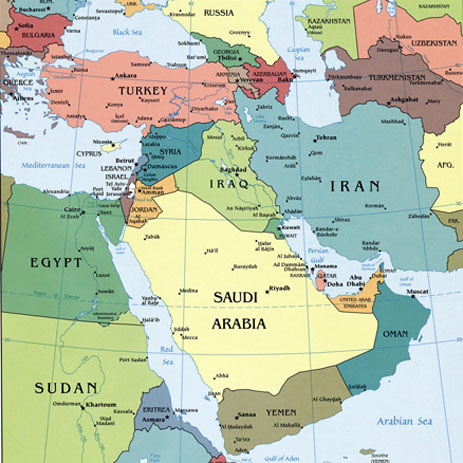
The Middle East: Somebody still thinks it is incidental?

Everybody knows that selling oil in any currency other than the USD is very dangerous, let it be EUR (Saddam Hussein) or gold (Muhammar Al-Gadhafi).

Let's look at this Middle East map:


From Zerohedge, the Iranian currency, the rial, has crumbled a 70% since the EU and the USA imposed sanctions on the country.
When President Obama signed the Comprehensive Iran Sanctions, Accountability, and Divestment Act, in July 2010, the official Iranian rial-U.S. dollar exchange rate was very close to the black-market rate. But, as the accompanying chart shows, the official and black-market rates have increasingly diverged since July 2010. This decline began to accelerate last month, when Iranians witnessed a dramatic 9.65% drop in the value of the rial, over the course of a single weekend (8-10 September 2012). The free-fall has continued since then. On 2 October 2012, the black-market exchange rate reached 35,000 IRR/USD – a rate which reflects a 65% decline in the rial, relative to the U.S. dollar.
In my opinion, the end game is in sight. Energy resources will be controlled by a small elite, and most of us will perish or will be become defacto slaves. A very nasty future lies ahead.
Posted by Analytic Bastard at 12:46 PM 0 comments
Labels: crisis, currency, Economy, Energy, inflation, Iran, USA

Thursday, September 20, 2012

Watch this!

Youtube user GGPGrey produces a high quality entertaining videos that might teach you something that you don't know. He has a unique style that will make you love it. You can recognize some elements from the Monty Python, Star Wars, Futurama...

The City of London:


Death to pennies:

 5 Historical Misconceptions Rundown:


Enjoy
Posted by Analytic Bastard at 11:27 AM 0 comments
Labels: finance, humor, inflation, Money

Thursday, August 30, 2012

Understanding debt

Via QuantNet and the Crooked Timber, I found interesting information about a former Yale professor that was allegedly fired in 2005 because of his anarchist political views. David Graeber has just published his book "Debt: The First 5,000 Years" which offers an infuriating insight according to the reviews, including one in the FT. He is currently professor at the London University.

Other interesting interviews include the one in nakedcapitalism.com, an insightful review of Graeber's book by Benjamin Kunkel at LRB, a 6-page article on David Graeber in Businessweek and an hour-long interview broadcasted by C-Span's BookTV.

From the nakedcapitalism.com interview:
So really, rather than the standard story – first there’s barter, then money, then finally credit comes out of that – if anything its precisely the other way around. Credit and debt comes first, then coinage emerges thousands of years later and then, when you do find “I’ll give you twenty chickens for that cow” type of barter systems, it’s usually when there used to be cash markets, but for some reason – as in Russia, for example, in 1998 – the currency collapses or disappears.
Also interesting are a 2002 essay by Graeber in New Left Review and an interview by Charlie Rose five years back.

The FT review includes an interesting paragraph about debt forgiveness and modern creditor protection which I agree 100 percent on:
But in the western world today, governments are intent on protecting creditors, not debtors. What makes the west an outlier, in other words, is not just the presence of credit cards or the existence of virtual credit, but the reluctance of leaders to countenance programmes of widespread debt-forgiveness of the type that used to be found in Mesopotamia.
Can we really blame creditors with an honest heart? It is true that for every sad story of someone getting sick and getting into debt, you have stories of irresponsible spending. Does the citizen deserve to be protected from a self inflicted injury? One can say that there is no moral misconduct of creditors when grating loans. However, this is tricky because there are two overlooked but important points:
  • Asymmetric information: lenders are a group of highly skilled individuals that resort to 300 hundred years of mathematical probability, whose organizations are vast collectives of actuaries, quants, fianncial analysts and executives with a lot of relationship to power spheres.
  • Fiat money and fractional reserve banking. Inflation depletes the individuals' ability to get in business by their own means and forces them to resort to lenders. At the same time, these lending institutions have an easy access to credit at cheaper rates.
That is what bankruptcy is for. Bankruptcy was pretty revolutionary when it came about. It allows people to make mistakes and in get out of them. If you have too much debt, simply go bankrupt. You won't be able to get a loan and it will mark your credit, but maybe you need a 7 year cooling off period to get your life in order.

He carried out an interesting discussion about his book. Here is an especially stimulating piece:
This summary of my economic theory traces how industrial capitalism has turned into finance capitalism. The finance, insurance and real estate (FIRE) sector has emerged to create “balance sheet wealth” not by new tangible investment and employment, but financially in the form of debt leveraging and rent-extraction. This rentier overhead is overpowering the economy’s ability to produce a large enough surplus to carry its debts. As in a radioactive decay process, we are passing through a short-lived and unstable phase of “casino capitalism,” which now threatens to settle into leaden austerity and debt deflation.

This situation confronts society with a choice either to write down debts to a level that can be paid (or indeed, to write them off altogether with a Clean Slate), or to permit creditors to foreclose, concentrating property in their own hands (including whatever assets are in the public domain to be privatized) and imposing a combination of financial and fiscal austerity on the population. This scenario will produce a shrinking debt-ridden and tax-ridden economy.


The latter is the path on which the Western nations are pursuing today. It is the opposite path that classical economists advocated and which Progressive Era writers expected to occur, given the inherent optimism of focusing on technological potential rather than on the political stratagems of the vested rentier interests fighting back against the classical idea of free markets and economic reforms to free industrial capitalism from the surviving carry-overs of medieval and even ancient privileges and essentially corrosive, anti-social behavior.


Today’s post-industrial strategy of “wealth creation” is to use debt leveraging to bid up asset prices. From corporate raiders to arbitrageurs and computerized trading programs, this “casino capitalist” strategy works as long as asset prices rise at a faster rate than the interest that has to be paid. But it contains the seeds of its own destruction, because it builds up financial claims on the assets pledged as collateral – without creating new means of production. Instead of steering credit into tangible capital formation, banks find it easier to make money by lending to real estate and monopolies (and to other financial institutions). Their plan is to capitalize land rent, natural resource rent and monopoly privileges into loans, stocks and bonds.

Another author with views on debt is Michael Hudson, who has published his new book, The Bubble and Beyond.

See also http://jacobinmag.com/2012/08/debt-the-first-500-pages/

Update: I just found out an oldie entry from mathbabe's blog regarding Graeber's latest book which I will draw a few conclusions from:
1) Debt came before money, often in the form of gift giving (you can read about this in his interview with Naked Capitalism)

2) In ancient cultures, and even in more recent cultures before the introduction of money, there were typically two separate spheres of accounting: the first was for daily goods like food and goats, which worked on the credit system, and the second for rearranging human relationships. Here there were things like dowries and symbolic exchanges of gold, meant to acknowledge the changing human relationship, but not as a “price” per se – because it was understood that you couldn’t put a price on a human.

3) Money as we know it is intricately tied in with slavery because it was when a person became a thing that could be sold for profit that we had a sense of price and when these two separate spheres were united. In particular the existence of money also implies the existence of a threat of violence. Moreover, it is this “decontextualizing” of people from their homes, their communities, and families who are forced into slavery that allows us to measure them with a dollar value, and in general it is only through pure decontextualizing that we can have a money system. It is this paradigm, where everyone and everything has no context, that economists rely on to describe the standard game theory of economics.

4) There are three social structures that people come into contact with in their daily lives and in which they give each other things: communistic, reciprocal, and hierarchical. For example, among parents and children, it is communistic; among a CEO and his workers it is often hierarchical, and among two strangers at a market it is reciprocal.


Posted by Analytic Bastard at 11:37 AM 0 comments
Labels: banks, Credit, debt, finance, inflation, Money

Monday, August 27, 2012

Silver bears: a compilation

The Canadian trader/blogger SGS has taught us while amusing us with his original silver bears video series. I remember how anxious I was waiting for the new episodes. His unique sense of humor was the perfect framework to present the conspiracy to the layman, the amateur and the professional. Economists wished to know what is contained in these videos.

Though I want to take the conspiracy with suspicion, I reckon there is much sense in what they say about protecting paper assets through monetary metals suppression. I just say that if Mickey Mouse is left with a mess to clean and he finds a magic wand, he just uses it, doesn't he? "I do it because I can".

Here is a compilation of all eight bears videos:


Posted by Analytic Bastard at 4:26 PM 0 comments
Labels: banks, Bernanke, Bonds, Central banks, ECB, Economics, Economy, Fed, finance, Gold, humor, inflation, investing, Money, Silver, trading, Wealth

Saturday, August 25, 2012

Marc Faber video

Inflation, deflation, the Fed, ECB and the usual suspects, get farmland folks!

An interesting video, watch and listen:


Posted by Analytic Bastard at 6:55 PM 0 comments
Labels: Bonds, bubble, crisis, deflation, ECB, Euro, Europe, EURUSD, finance, Germany, inflation, Marc Faber, USA

Thursday, May 31, 2012

A tale of exponential interest

Imagine you have a savings account and you deposit an amount. The bank transfers the interest to your account and the next time you get interest on your principal plus all the interest transferred to you until that time.

This is known as compounding interest. In my more technical blog I derived the interest paid to that account, see it here. It is a differential equation whose solution is the exponential function
$$e^{kt}$$
Where k is the interest given by the bank.

Could everybody be infinitely rich? Of course not. For these interests to be payable either there is debasement of the currency or the market should be flooded with products manufactured at the expense of this planet's billion-year energy reserves (be more aware of what surrounds you, you can download for free the excellent manuscript by D. MacKay). Until today we have used the second option. If we run out of energy, the first option will come suddenly.

Also read the interesting post at Do the Math displaying the views of an economist and a physicist about the topic. Some excerpt for your delight:
Physicist: Before we tackle that, we’re too close to an astounding point for me to leave it unspoken. At that 2.3% growth rate, we would be using energy at a rate corresponding to the total solar input striking Earth in a little over 400 years. We would consume something comparable to the entire sun in 1400 years from now. By 2500 years, we would use energy at the rate of the entire Milky Way galaxy—100 billion stars! I think you can see the absurdity of continued energy growth. 2500 years is not that long, from a historical perspective. We know what we were doing 2500 years ago. I think I know what we’re not going to be doing 2500 years hence.
Posted by Analytic Bastard at 2:19 PM 0 comments
Labels: compound interest, Credit, Energy, inflation, Money, speculation

Wednesday, May 9, 2012

The turning point and the next leg in Gold

We have been warned about further near-term weakness in gold and pretty much else by prominent investors such as Jim Rogers (link here)
That is not to say that gold is bulletproof. In fact, Rogers says a gold price correction could happen sooner rather than later, and the downside is USD1200 - USD1300 a troy ounce.
and Marc Faber (link here)
Gold may not perform very well in the near future. The gold market has performed so well, we could have some setback.
Which is part of a broader market weakness stressed again by Marc Faber (link here)
The market is vulnerable. Many stocks sell off on news that is not really bad, but not just as good as expected. So I am of the view that maybe we have something more serious here.
Bear in mind that no asset will inflate more without additional monetary stimulus. The inability to generate profits at the same pace than overall interest payments due to sustained high energy prices is burning the money that solvent businesses have. A credit implosion burns money and removes liquidity, creating a monetary deflation whose effects are similar to the Great Depression. This is what Bernanke knows, but I don't know whether he has factored in the true importance of oil in the equation.

In any case, without monetary easing, equities will crash, draining liquidity out of the system and making several institutions insolvent, which will spur fear into the already weakened markets and will drive them further down. That is the signal Bernanke is waiting. I've been hearing talk about further QE since April 2011, but Bernanke is an elegant guy and will not let politicians, economists and the broad public criticize him over QE. They will have them begging him for more QE. And that moment will come once equities crash.

This scenario is a market-wide collapse in which only one asset would survive: oil in case of a conflict with Iran, an option that has become increasingly likely. Short everything, long oil.

Concerning gold and silver, bloggers Dan D. from The Fundamental View, Mr. Hui from Humble Student of the Markets, and of course the previously mentioned investors Jim Rogers and Marc Faber, and myself, are expecting further short-term weakness that will make the metal plunge (for the last time in my opinion) until reaching the max pain point of many investors, only to recover after institutional investors (not the small investor) counts on immediate easing. Look for a massive drop in both the price and open interest in the COT (Commitment of Traders). I am no chartist (and I could use one), but I believe that USD18 to USD20 could be a bottom for silver in the worst-case scenario, that would revert all gains from QE2. That would put gold in USD1260 to USD1400 using a crashed-BDI ratio of 70. I chose this ratio because it would coincide with low industrial demand for silver, and would correlate very well with another plunge in the Baltic Dry Index.


I believe the 1260 number is appealing to technical chartists, since it is the bottom gold made back in 2010. This figure is also in the range Jim Rogers is saying in the media.

So, wait for those beautiful Chinese 2012 silver pandas to fall into your hand at incredibly cheap prices. Be patient, buying silver will again be profitable and a very good investment because it will react with the same strength as it did in 2011.

And if you plan to trade these markets, trade safe and good luck.

DISCLAIMER: I have no position in commodities at this time, nor I plan to open any position in the near future.
Posted by Analytic Bastard at 4:21 AM 0 comments
Labels: currency, Economics, Euro, EURUSD, Gold, inflation, interest rates, Jim Rogers, Marc Faber, Money, Silver, trading

Monday, April 30, 2012

The Kingdom of SBain

Every news site and blog I follow is releasing pieces about Spain. I have a lot of friends, acquaintances and many interests in that country, so I can add some thoughts to the discussion.

So, let's recap:
  • Mainstream media report that unemployment is not a problem for 75% of Spaniads. It is neither a problem for 45% of young people (16-25 years).
  • Public transport has risen twice year-to-date and is poised for a third one tomorrow.
  • Gas, electricity and water have risen.
  • Tuition has risen in a system that has no institution ranking amongst the 100 best ones. The price for one academic year is 2000 EUR.
  • While ordinary Spaniards cope with harsh austerity, recession and soaring unemployment, the Spanish king enjoyed a safari and ended up with expensive hip surgery.
  • The king's grandson, Foilan, shot himself on his foot while illegally handling a gun with his father and had to be taken to the hospital.
  • The king's son in law, Urdangarin, was accused of laundering public money in tax havens.

Still not happy with the summary above? Zerohedge reports that Egan Jones Cuts Spain For Second Time In Two Weeks, From BBB- To BB+. On top of that, "assets of Spain's largest two banks exceed its GDP". Now, how on earth can the balance sheet of two banks be larger than the economy supporting those two banks?

Dan D. is also commenting on the Spanish situation. He correctly states that "Greece was literally a day at the spa for what is about to hit Europe". I put a comment there that I reproduce here for convenience:
Luigi DraghiApr 30, 2012 01:37 PM
I believe their way out is creating a southern euro and a mechanism for foreign investors to cover internal devaluation for their investments. They NEED to steal wealth, and the way out is making people pay sovereign and bank debt via inflation and taxation.

The Spanish government passed a law which makes foreign current/savings/brokerage account disclosure mandatory for Spaniards. Failure to report foreign accounts leads to 5000 EUR per non-reported account. That tells me the EU has already made its mind about some Plan B (or C or D...) in which southern countries will be insulated without (de iure) expelling them from the monetary union. With this new law and the new southern euro, foreign accounts could be taxed as capital gains.
I already wrote about this ( http://federalreverse.blogspot.com/2012/04/spanish-corralito.html )
At this juncture, no European government is safe for investing. However, even if investors are forced to take haircuts, the real smash will be felt by the population. If you are European, especially if you are Spanish, know that your taxes are collateral for your banks.
Posted by Analytic Bastard at 3:20 PM 0 comments
Labels: Bonds, corralito, ECB, inflation, Spain, Wealth

Saturday, April 28, 2012

The grand trick of fiat currency

I met a retired Spanish policeman yesterday and had some beers at a pub. This guy has had a vital experience that is worth the envy of any spy movie character, which is something of note given his "limited" education (and lack of better terms to describe). I had not seen this guy for 4 months and I always enjoy his company. Having been destined to the Ukraine, having no less than five mistresses there, and currently collaborating with the secret service, it was time to share a drink.

After catching up, he brought up the issue of investments. He participated in Bankia's (BKIA.MC) public offering and I recommended he closed down the position because once the stock carer JPMorgan stopped lifting the stock price, it would come down very quickly. He chose to follow the advice of his financial advisor at the bank instead of mine and now he is losing one third of his position. I still recommended him to get out and he told me he could not make losses so he would wait to sell... here is some sheeple mentality.

Then we turned to monetary issues, I wonder where he had heard that since I don't usually talk technically to these people. He asked me straight: "What happens if they devalue the currency, let's say that I have 300,000 EUR in a savings account, would I have the same 300,000 EUR if they devalue the currency?" and I answered "yes, you would nominally have 300,000 EUR, but you would be able to buy much less" and he said, "OK, that's OK then". I did not go further into that conversation because I was not behind a bank desk and my words would fall into oblivion.

So there you have it, sheeple wanting to be sheeple, forever and ever. You could not lie to this guy on the street and you would not leave alive if you did but dress white collar and he would put all his money in the financial ponzi of your choice. Bankers are very bright people indeed and their fiat currency scheme, playing with absolute and relative concepts, is truly a great masterpiece.
Posted by Analytic Bastard at 5:43 AM 0 comments
Labels: currency, inflation, Money, Wealth

Saturday, April 21, 2012

Two videos we always enjoy

Grab popcorn, please use a 42" screen, enjoy:


Posted by Analytic Bastard at 5:00 AM 0 comments
Labels: Bonds, credit rating, Gold, inflation, Money

Friday, April 20, 2012

Monetary contraction, deflation and gold

Societies and their economies are complex systems that are not easily explained and whose dynamics are too complicated to be captured by statistical and econometric linear models. These linear models come from the linear nature of human thinking.

I hear people that favor the theory of an imminent sudden inflation as credit and the monetary base expand, and others that believe the only thing we will see is a job-destroying deflation that will only be stopped by a centrally-planed monetary policy.

What I think is that both maybe right. The only question is timing, just the same as the markets. Markets can stay irrational longer than you can stay solvent, says a market saying. The general economy may refuse to follow the path designed by planners because there is more to the economy than just the monetary base plus credit. The economy needs energy to move, and energy can't just be printed. The less energy you have, the more restrictive credit and money become if unstable economic processes are to be avoided. Therefore, the use of credit and money has the effect of a drug for the economy. They can boost it during some period, but the sustained use of those must be matched by an equal sustained use of energy. If no new energy is added to the system, inflation will appear but, at the same time, asymmetric access to credit and money can lead to deflation in those sectors affected by a late access to them. However, this is nothing but transitory, and money will flood the markets like a tsunami as credit is suddenly liberated by banks, usually responding all at once to a fear stimulus.

That is brilliantly described by Mike Maloney at his conference in Puerto Rico. His thesis, which I support, describes a scenario in which first a deflation will occur, and then an inflationary or hyperinflationary process will start some years later.

I think that is what we are seeing now. As I reported, the M1 monetary base is contracting in the Mediterranean countries and credit is inflating the housing bubble in Germany and Austria.

For this reason, gold may go down in the following months and still be an excellent investment, maybe the investment of your life. Do not pay attention to the permabull gang of KWN, they sell bullion, they tell you it is a bargain at USD600 and at USD1900: if it goes down is on manipulation and is forming a bottom, if it goes up then we are days away from going to infinity.

Jim Rogers and Marc Faber, who I regard as two stand-up and achieved investment professionals and honest individuals, have been saying in numerous occasions that gold dynamics are very strange and they expect some kind of important correction. Pay attention to them, they tell you for the sake of telling you. Make a little room in your heart for deflation.
Posted by Analytic Bastard at 1:49 PM 0 comments
Labels: Bernanke, deflation, ECB, Economy, Energy, Euro, Europe, Fed, Germany, Gold, Greece, inflation, interest rates, Jim Rogers, Marc Faber, Portugal, Spain

Monday, April 16, 2012

Spanish corralito

Argentinian readers know very well what I say with the word corralito. Back in 2001, Argentinians were happy buying foreign products when the Argentinian Peso-USD peg was at full speed. However, one good day at the end of that year, when there were no more dollars left in reserve, the insanity was suddenly over and those dreams based on the lie in which they had dollars deposited in their bank accounts crumbled with no warning. People rushed to the banks to withdraw dollars as a reaction to the news of a Peso depeg, and demanded USD back, invoking the cognitive dissonant normalcy bias they had been surrounded with for years. Obviously they were answered to suck it up and go home, with their Pesos, if they wanted. Families' fortunes were decimated in just a few days.

As per the law just passed last Thursday, the subjects of the Kingdom of Spain must disclose any bank or brokerage account they have abroad. Also, an unprecedented financial amnesty was declared by the government to repatriate up to 2,500 million EUR. My take on this is that the Spanish government is seeking to repatriate these funds not only as a desperate measure to boost the economy, but also as a means to have access to more capital when a possible southern Euro is introduced in Spain.

I arrived at this conclusion by considering that if the euro falls, so does Europe itself, and such a powerful Mammoth will fight to survive, even if it means exhausting everyone underneath. Also, taking into account the inflationary means by which the currency issuer has access to the currency users' wealth, and that it is impossible for Spain to pay back the principal plus the interest of both private and public debt, namely by:
  • An European/IMF bailout
  • BCE LTRO to infinity
  • Spontaneous industrialization and trade surplus achievement
and jointly with the taxation and possible forced repatriation of private funds thanks to the mentioned disclosure law, the most likely solution under my point of view is that the plan of a two-speed Euro might already be in place.

This would be simple: They would say that Europe has not failed since a basic framework of free commerce is preserved. However, people living in the south would struggle to maintain their wealth, and getting Southern Euros to the north would be extremely penalized.

As a first step, only residents of a country would be allowed to exchange their old euros to the newly issued north or south euros at a 1/1 exchange rate in that country, at par with their northern neighbors, ECB guaranteed an all. Savvy southern travelers will try to get some northern euros in their hands but they will be denied amounts that exceed ordinary expenses. Then, as the devaluation commences in a controlled but perceivable way, the general public will flock to their banks, demanding northern euros just as ECB/State/EU had reassured and they will be slapped in the face. At that moment, maximum amounts in withdrawal would already be in place and all electronic transactions would be under strict financial scrutiny by the state treasuries. Such a controlled but steady devaluation with closed boundaries will immediately be met by internal capital flows. Semi-large fortunes will invest their capital in state-denominated job-creating assets, while others will try to get anything they can to preserve value, but everything will be heavily taxed: gold, farms... even housing would (internally) experience some kind rebound, relatively alleviating pressure on big banks at the cost of Juan taxpayer. This means that most of the powerful families will react rapidly and maintain or relatively increase their wealth, while the working class will be made poorer.

From the outside, a mechanism of safe trade would be made available to foreign investors (yes, you have to think bureaucratically), which would act like some form of firewall. Thus, stored wealth and cheap labor could be harnessed by southern countries under the umbrella of inflation without disrupting the northern economies past the upcoming LTRO3 (which are already experiencing unpleasant bubbles).

There are many more problems ahead. Contrarily to what some analysts say, Spanish housing prices have not tumbled since banks have refinanced realtors and home builders during the last four years, even though they have been broke since the peak of 2008. The public and the international investor still need to see what those banks' balance sheets really look like. And Spaniards still need to experience the true meaning of corralito when they finally realize the argentinization of Spain.
Posted by Analytic Bastard at 4:24 PM 0 comments
Labels: corralito, ECB, Euro, Europe, inflation, LTRO, Spain

Thursday, April 12, 2012

A piece of advice... by the IMF

While reading ZH, I found this piece of news and I said WOW:
Further confirmation of gold’s continuing but gradual renaissance as a safe haven asset was given by the IMF yesterday who warned that a “growing shortage of safe assets” poses a threat to “global financial stability.”  The IMF identified $74.4 trillion of potentially safe assets today, including gold, investment grade government and corporate debt, and covered bonds. Sovereign debt crises are reducing the number of governments that investors trust to issue "risk-free" bonds just as new financial regulations are increasing demand for safe securities from banks. Importantly, the IMF’s latest Global Financial Stability Report’s introduction finds that  "In the future there will be rising demand for safe assets, but fewer of them will be available, increasing the price for safety in global markets.” “Both the lack of political will to reshape fiscal policies at times of rising concern over debt sustainability and an overly rapid reduction of fiscal deficits limit governments’ capacity to produce assets with low credit risk.” The IMF has warned regarding illiquidity in “safe haven” markets. Gold remains one of the most liquid markets in the world and the illiquidity in bond markets would see increased safe haven demand for gold.  The IMF is warning regarding deteriorating public finances. As many governments see themselves being downgraded - safe haven bonds may become less safe.
I have no doubt that financial elites are already positioned in gold, and have been for very long. Gold is a storage of wealth, equivalent to the work needed to extract it. It is not subject to the laws of supply and demand the same way other commodities are since its monetary component must be factored in. With the previous article, even the IMF, the very core of the financial monetary and credit system, is telling you.

I was able to detect the past week's temporary bottom with the help of a growing divergence of Gold/EUR ratio. With today's rumors about an incoming QE3, I have even more reason to celebrate. And if it turns down and falls, to quote Jim Rogers, I hope I am smart enough to get some more.

What the IMF is telling you is that energy is a scarce resource, and so is wealth, but currency is created and manipulated at will. In fact, the IMF is just expressing the theory of thermodynamical economics. But gold is beyond human manipulation and there might come times when trust is no longer assumed by every counterparty.
Posted by Analytic Bastard at 6:27 PM 0 comments
Labels: crisis, Gold, IMF, inflation

Sunday, April 8, 2012

Towards a thermodynamical theory of Economics

Even though Economics is a topic studied at every college and university, I believe their core fundamentals are not only misunderstood but also not even identified.

When I speak with economists, they fool around specific ideas they learned, but I came to realize that economic systems are nothing more than physical systems, and the same concepts and rules should apply.

If we admit that the economy is a physical system whose magnitudes change with time and in space, we need to match economic concepts to those of Physics. I propose to identify energy to wealth, work to labor and heat to money. Then we inherit the set of laws of thermodynamics. In particular, if we consider the economy in a society as a set of hierarchical thermodynamical systems, it is evident that the
  • First law of thermodynamics: Heat and work are forms of energy transfer. While energy is invariably conserved, the internal energy of a closed system changes as heat and work are transferred in or out of it. Equivalently, perpetual motion machines of the first kind are impossible.
comes in place when somebody (first) does some work for a second person (another system). Wealth (energy) has been transferred by the labor executed by the first person to the second in the form of an elaborated product that could not have existed without the first person losing energy (transferring it in the form of work to the second person). If it is expected that the first person received a monetary compensation, the energy loss is therefore restored if this compensation is "fair" (in abstract terms of the money transfer being equivalent to the labor transfer). If the person executing the labor is a slave, this reduces to a system that continuously transfer energy out of it, much in the way the sun does, or does the process creating crude oil (both transfer energy to the human society as a whole system, and at their expense).

It is also evident that someone that has more money can move faster and farther away than someone whose occupation is mundane and provides a low income. This fact reinforces this thermodynamical view of Economics.

Studying inflationary and deflationary processes under these lenses would provide new insights into wealth transferring periods. In this theory, money is just a mean for wealth (energy) transfer, not for wealth storage. In this sense, a natural distinction can be made between paper currency and hard monetary assets such as gold. Both serve as wealth transfer mechanism (heat), but only one is stable.

Under this theory, crude oil would have a much deeper impact on the economy than just a mere impact on industrial manufacturing prices. Much more than that, oil would provide the energy needed for the system to growth (and especially to cope with the compound interest and the exponential growth it requires). Crises and equity peaks can easily be explained and predicted (disregarding timing).

Unless economists take a more humble position and view themselves as just a part of the whole body of laws that govern the entire universe, and not take refuge under the excuse that the "complex human behavior" makes the theory different, we will be doomed to hear experts predict decades of booming economy at peaks and missing opportunities at bottoms.
Posted by Analytic Bastard at 6:14 AM 0 comments
Labels: Central banks, Credit, deflation, Economics, Economy, Energy, Gold, inflation, Money, Wealth

Saturday, April 7, 2012

Inflationary concerns

Zerohedge has regularly been reporting the ECB's deposit facility that the banks use as storage, much in the same way a customer uses a current account with his bank (except that they are penalized for not putting this fresh credit-created money in circulation). As ZH reports, banks have been depositing the whole of both LTRO 3-year loans in those accounts. This means that the current mood in the banks is not risk-prone and in line with a fear-driven deflation.


As of today, the banks seem to have found some place to allocate those funds, most likely in sovereign debt.

As I noted previously, prices are going up in those countries less affected by the crisis. In those countries, credit-based assets are going bubbly. In the whole EU, food and basic products are seeing how the money that was supposed to be destined to pay the now-underwater mortgages and other credit-based products acquired over the past ten years is duplicated and redirected to basic products by the chain created by ECB-banks-states. In this case, prices simply go up in creditor nations (Germany, Austria...) whereas they are stable in debtor nations (Spain, Portugal) due to retail and industrial margin reductions.

This will have the effect of wiping out retailers and manufacturers in southern countries, while creating housing bubbles and general inflation in central countries. And this will not end here: both LTRO programs, surpassing 1 trillion EUR, and the risk of the need for another 3.0 version, is a money stream with enough pressure to break the fear-deflationary dam that currently prevents it from flooding the markets and spurring the effect of losing confidence in the currency and its issuer.

As I say: brace yourselves.
Posted by Analytic Bastard at 7:02 PM 0 comments
Labels: Bonds, CDS, Central banks, Credit, deflation, ECB, Europe, Fed, Germany, Greece, inflation, Money, Portugal, Spain

Thursday, April 5, 2012

I got myself some gold yesterday (with an outlook)

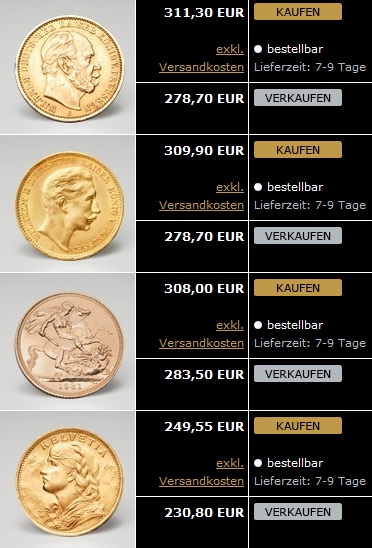
I often follow the stock in Geiger Edelmetalle, since they show the coins they have and the number of each when you place your order. Here's a screenshot of four fractional-ounce coins that I have found to be out of stock in gold rallies.

The first is the 20 gold Mark Kaiser Wilhelm I, winner of the French-Prussian war and founder of the German Empire. These coins are more loved by the German people in comparison to his grandson Wilhelm II, even though their state is normally poorer due to a larger circulation (they were valid from 1871 until the first world war, whereas those of the grandson went from 1891 on, and larger mintages of the grandson's image are dated in the 1900). This means that coins depicting Wilhelm I are depleted quickly, whereas Wilhelm II 20 gold marks tend to remain in stock.
This is the British sovereign. This is a coin that is also depleted quickly due to its national origin (it is interesting to own national coins since they are the most accepted ones in their respective countries).
Lastly, we have the Swiss Vreneli 20 francs, another popular coin and usually found in ample supply.

Were these four coins missing, along with some of the one-ounce coins, I would be inclined to say that there is physical market pressure on the price. However, as we can see as of April 5th, the four coins remain in stock. I think that sustained high prices (with a record in EUR) have provided shops with more stock, and physical market pressure is relieved.

However, a good strategy when investing in gold is averaging on the downside. With the metals plunging during two straight days, and gold price not that low since January, it was time to raid a shop. This does not mean that I think it won't continue sliding. USD1500 is fully believable. It may coincide with a market-wide spring sell-off in a deflationary context, and in that case the drop might be much larger. The chart in EUR tells me there is some barrier at EUR1350 that gold was not able to cross and, thus, it has to take a breath. On the other hand, the problems in southern Europe lurking, are poised to surface again. This has been proven to be true, at least partially, with today's EUR dumping across the board. At that time, it was clear that the minimum for the day was in (assuming normal trading). The elements for averaging on the downside were on! The price per ounce I got yesterday was EUR1265 (Krugerrand, not in Geiger). Today it is EUR1282, not a bad deal!
Posted by Analytic Bastard at 8:23 AM 0 comments
Labels: Central banks, deflation, ECB, Gold, inflation, Silver

Monday, April 2, 2012

Our fiat monetary system

If von Misses sounds to you like you left something at home, in the same line that our previous post, here you have, via Zero Hedge:


And this quote by George Washington, also selected by ZH, but that I want to carbon copy here along some other fitting quotes:
"Paper money has had the effect in your state that it will ever have, to ruin commerce, oppress the honest, and open the door to every species of fraud and injustice"
George Washington -- in a letter to Jabez Bowen, Rhode Island
“The first panacea for a mismanaged nation is inflation of the currency; the second is war. Both bring a temporary prosperity; both bring permanent ruin”
 Dr. Marc Faber quoting Ernest Hemingway in the CFA Institute Middle East Investment Conference
"I will pay cash or pay nothing." "I will never resort to irredeemable paper money"
Napoleon Bonaparte
"Let me issue and control a Nation's money and I care not who makes its laws"
Mayer Amschel Bauer Rothschild

Posted by Analytic Bastard at 1:44 AM 0 comments
Labels: Central banks, Credit, debt, ECB, Fed, Gold, inflation, Marc Faber, Money, real estate, wages

Sunday, March 25, 2012

Prices gone berserk in Germany

There are many news reporting high inflation in Europe in general: food, fuel, and so on. But, how bad are the money shots in real estate prices in Germany? this is very serious. This fresh credit and money printing via the ECB's balance sheet expansion is doing a very pernicious effect, i.e., raising prices, which reduces competitiveness. Merkel knows this well, and knows that this inflation and these money shots are not what Germany needs.

Furthermore, this creates the same housing bubble that was created in southern countries, especialy Spain. Here are some news signal an active inflating market:
Warum der deutsche Häusermarkt jetzt boomt 
Makler sehen jetzt die richtige Zeit zum Kauf 

What is happening, as I say, is that many banks in Germany and Austria are not funding commercial projects, but simply going into real estate. This produces a corrosive inflation: rising property prices hinders productive investment, as the growing costs of premises and the flow of money out of the industry makes it impossible to undertake a project, leading to an erosion of Germany's industrial economic edge. Do you really think that Merkel will let house prices to continue to rise by 10-15% annually? This is not sustainable and I expect the German government to take action in some way, most likely confronting ECB's president Draghi. On the other hand, housing prices in Austria are going crazy. An acquaintance reported a fifth-floor, 140 square meters penthouse selling for 1.2M €. This acquaintance, who has lived there for 25 years, has never seen anything like it: many food items have doubled in just one year, and certain not so basic, but necessary products have tripled in nine months. Inflation is also inflating commodity prices, it is not uncommon to find bread for 4 € in Billa or Merkur supermarkets, which would be unthinkable just a year ago. What this means is that money thought to reactivate Portugal or Spain is moving around and wreaking havoc in European creditor countries.

At this juncture, I believe that some action to move rates higher will be taken. They will, or maybe already have, abandoned Spain and Greece, Ireland and Italy, and the Euribor, the main housing rates index, will go to levels close to those of 2008 and 2009. This would be a death sentence for those countries industries.


We can therefore say that the era of low interest rates in Europe is over. For those having a mortgage, especially in the peripheral countries, brace yourselves.
Posted by Analytic Bastard at 7:00 AM 0 comments
Labels: Central banks, commodities, debt, ECB, Germany, inflation, interest rates, real estate
Older Posts Home
Subscribe to: Posts (Atom)

Energy


Precious metals

gold coin prices junk silver coins

Popular Posts

  • Debunking Jim Rogers on farming
    Jim Rogers has been speaking a lot about farming being the profession of the future. Now, I love his insights and I regard him as one of the...
  • Spanish housing bubble and economic annihilation
    I came across this wonderfully made video that would be a total LMFAO if there were no people suffering from the topic it talks ...
  • Towards a thermodynamical theory of Economics
    Even though Economics is a topic studied at every college and university, I believe their core fundamentals are not only misunderstood but a...
  • A tale of exponential interest
    Imagine you have a savings account and you deposit an amount. The bank transfers the interest to your account and the next time you get inte...
  • Two videos aus Deutschland
    The first starts with Dirk "Mr.Dax" Müller, slamming the door pretty hard on those that only see an unlikely interest rate ...
  • Prices gone berserk in Germany
    There are many news reporting high inflation in Europe in general : food, fuel, and so on. But, how bad are the money shots in real est...
  • Beware Chinese phones!
    I recently bought a "Quad core 1 GB" "Huawei" "Mate Mini" phone from Ali Express. I use quotes because none of...
  • The truth about Jack Andraka
    The truth about Jack Andraka is... that I don't know it, obviously, I am a normal citizent with my mundane whereabouts and I am geograph...
  • Beautiful spectacle in the sky
    I enjoy Astronomy so much that I examine the night sky every time I can. Tonight I couldn't wait to describe the delightful sight in t...
  • That raid of mine proved to be wise after all
    For those of us who live in Euroland, it is very important to observe Gold/EUR correlations, since an extreme deviation from linear correlat...

Worthy analyses

  • SeekingAlpha.com: Home Page
    Hershey: The Stock Is Even Better Than The Chocolates
    6 hours ago
  • mathbabe
    AI Skeptics: The Future of Mathematics (with Aaron Abrams and Becky Jaffe)
    1 day ago
  • FOFOA
    Hyperinflation Book Club
    1 month ago
  • The Fundamental View
    Perumahan Murah di Pekalongan 2026: Subsidi, KPR, dan Info Terbaru
    3 months ago
  • Humble Student of the Markets
    A Time for Caution
    7 months ago
  • Shadow Government Statistics
    Flash Commentary No, 1460b
    5 years ago
  • www.zerohedge.com/fullrss2.xml
    The Oil Refinery Crisis Will Worsen This Winter
    5 years ago
  • Jim Rogers Blog
    Financial Markets Will Move To Asia
    6 years ago
  • Kyle Bass Blog
    Kyle Bass On China
    11 years ago
  • Big Picture Agriculture
  • SilverGoldSilver
  • Harvey Organ's - The Daily Gold and Silver Report
  • Marc Faber Blog

Label cloud

Europe (24) Spain (22) inflation (22) Economy (20) Gold (19) society (19) sociopaths (19) crisis (18) Money (17) debt (16) trading (15) Central banks (14) ECB (14) Germany (14) Economics (13) Credit (12) finance (12) humor (12) Greece (11) Energy (10) Euro (9) Silver (9) commodities (9) deflation (9) Bonds (8) Fed (8) USA (8) Wealth (8) banks (8) EURUSD (7) bubble (6) interest rates (6) Marc Faber (5) currency (5) farming (5) real estate (5) speculation (5) futures (4) normalcy bias (4) BFA-Bankia (3) Forex (3) Jim Rogers (3) investing (3) wages (3) Bernanke (2) CDS (2) France (2) Orwell (2) Portugal (2) UK (2) biology (2) corn (2) corralito (2) credit rating (2) hedge funds (2) oil (2) welfare state (2) wheat (2) Android (1) Astronomy (1) Bitcoin (1) Chavez (1) Crisis Trivia (1) ESM (1) Huxley (1) IMF (1) Iberia (1) India (1) Internet (1) Iran (1) Jack Andraka (1) LTRO (1) OWS (1) Venezuela (1) altcoins (1) chinese phones (1) college (1) compound interest (1) cotton (1) degree (1) hed (1) hum (1) lies (1) mone (1) regularization (1) splines (1) stocks (1) university (1)

Machinomics

Machinomics
Visit my blog about data analysis, financial applications and science